
This is the first question most Charleston homeowners ask us, and it deserves a straight answer: some popcorn ceilings contain asbestos, many do not, and you cannot tell which is which by looking. Age is the best clue, a lab test is the only proof, and the rules that apply to you depend on what kind of building you live in.
Here is what we tell every customer with a textured ceiling in a home built before 1990.
Did popcorn ceilings contain asbestos?
Yes, many did. Asbestos fibers were mixed into spray-on acoustic texture for decades because they added strength and fire resistance. Federal rules began restricting asbestos in these products in the late 1970s, but existing inventories were allowed to be used up, so texture containing asbestos kept going onto ceilings into the 1980s. Redfin notes that ceilings installed as late as the mid-1980s may contain it.
That is why you see so many different cutoff dates online. Local contractor pages around Charleston variously say 1977, 1978, 1980 and "mid-1980s," sometimes on the same page. The clearest official anchor comes from the South Carolina Department of Environmental Services (SCDES), which says buildings built before 1980 are the most likely to contain asbestos and specifically lists popcorn ceiling texture among common asbestos-containing materials.
Our rule of thumb is more conservative: test any textured ceiling in a home built before 1990. Testing is cheap, and the downside of guessing wrong is not.
Do all popcorn ceilings have asbestos?
No. Plenty of 1970s and 80s ceilings test negative, and texture applied in the 1990s and later almost never contains it. The 1980s is the single largest pre-2000 build decade in every tri-county market, including Mount Pleasant, Summerville, Goose Creek and North Charleston, so a huge share of Charleston popcorn ceilings sit right in the uncertain window. In older areas like West Ashley, where the 1960s and 70s were the biggest building decades, the odds of a positive result are higher.
Repairs complicate things too. A 1960s ranch may have had one room re-textured in 1995 with a different product. That is why we sample each distinct ceiling area rather than assuming one result covers the house.
How to test a popcorn ceiling for asbestos
SCDES puts it simply: a sample has to be studied under a microscope. There is no reliable home test strip or visual check. You have two options.
Mail-in lab sample
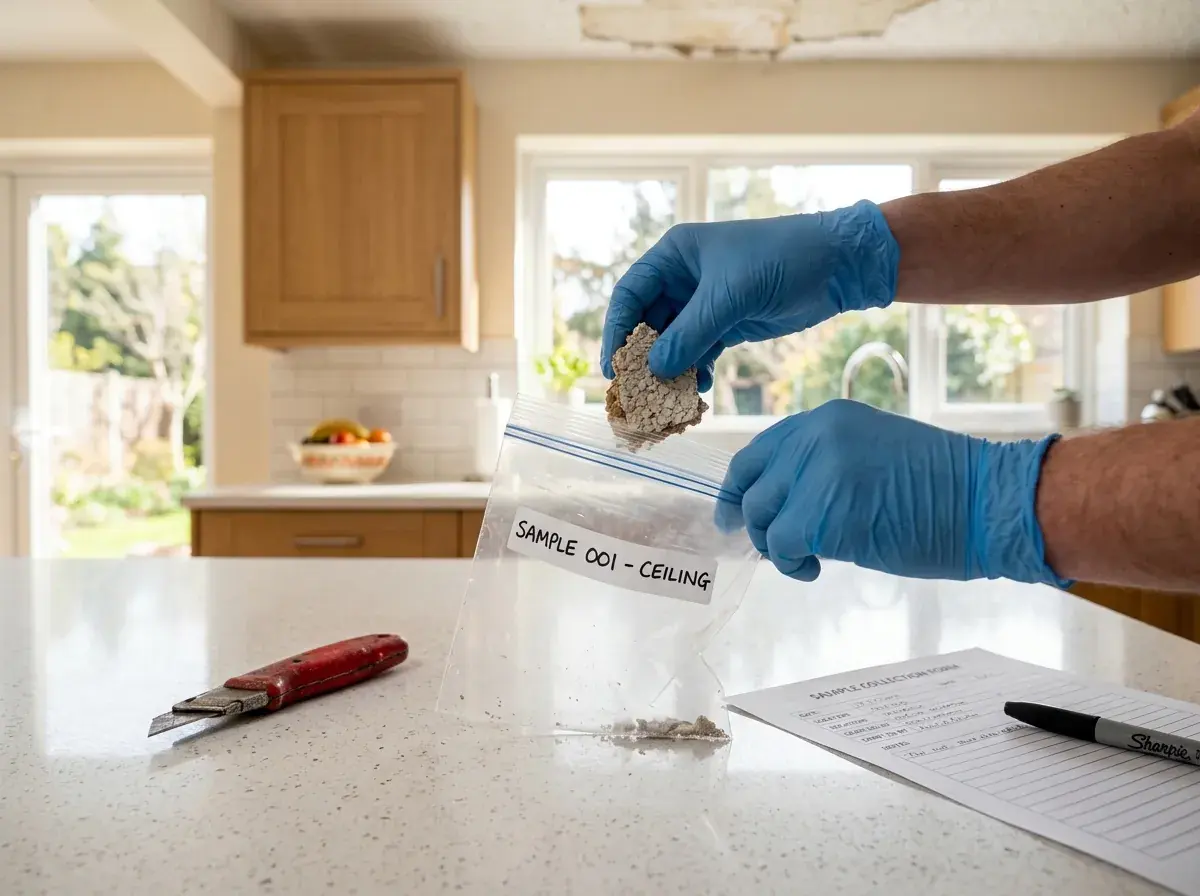
You (or we) take a small piece of texture, seal it in a bag and send it to an accredited lab. Typical cost is about $50 to $100 per sample. Results usually come back in a few days.
Professional inspection
A licensed inspector samples every distinct ceiling area, documents it and delivers a formal report. Typical cost is $250 to $850. This is the route you want if you own a condo, are selling a house and need documentation, or simply do not want to handle the material yourself.
When taking a sample, wet the area first with a spray bottle so no dust is released, cut out a small piece with a utility knife, and avoid grinding, sanding or tearing. If you would rather not, our asbestos testing service handles sampling and lab coordination before any removal work.
South Carolina asbestos rules: houses vs. condos
South Carolina's asbestos program moved from DHEC to the new Department of Environmental Services (SCDES) on July 1, 2024. The governing rule is SC Regulation 61-86.1, and the key distinction for homeowners is how many dwelling units are in your building.
Single-family homes and 1–4 unit buildings
Private residential structures with four or fewer dwelling units are generally exempt from the state's notification and licensed-inspection requirements. In plain terms, if you own a detached house in Summerville or a duplex on James Island, the state does not require you to file anything before cosmetic ceiling work. SCDES still recommends treating pre-1980 textured ceilings as suspect and testing them. And if you hire a contractor that holds an asbestos abatement license, that contractor must follow the full regulations even in a single-family home.
Condos, apartments and 5+ unit buildings
Condominiums and residential cooperatives are explicitly included in the regulated-facility definition, as are residential buildings with more than four units. For these, a licensed inspection is required before renovation, removal of asbestos-containing material must be done by a licensed abatement contractor, and SCDES must be notified in advance, with notice periods and fees that depend on project size. We cover the practical side on our condo and HOA ceilings page.
Interior finish work like texture removal and painting generally does not need a building permit in South Carolina; the asbestos rules are a separate environmental track.
What a positive result means
First, it is not an emergency. Intact, undisturbed popcorn texture does not release fibers. The risk comes from scraping, sanding or drilling into it, which is exactly what removal does.
Second, we are not an asbestos abatement contractor. If your sample is positive, we stop and refer you to an SCDES-licensed abatement contractor. Abatement typically costs $3 to $7 per square foot, and up to $5 to $20 in some cases. Once the abatement firm finishes and the area is cleared, we come back to repair the drywall, apply a smooth skim coat or knockdown texture, and paint.
Third, you have alternatives to removal. Some owners choose to cover a positive-testing ceiling with new drywall or leave it intact and paint it. Those are legitimate options to discuss with the abatement contractor and, if you are selling, with your agent.
What a negative result means
A negative result clears the way for standard wet-scrape removal. We keep the lab report on file for your job, and we recommend you keep a copy with your house records; buyers and their inspectors ask about it. From there the project is like any other, priced per our cost guide. Our popcorn ceiling removal service page explains the containment and scraping process.
Not sure where your ceiling falls? Request a free quote and tell us the year your home was built. We will tell you whether testing should come first.
Frequently asked questions
When did they stop using asbestos in popcorn ceilings?
Federal restrictions started in the late 1970s, but existing stock could still be used, so asbestos texture was applied into the 1980s. SCDES says pre-1980 buildings are most likely to contain it; we recommend testing any textured ceiling built before 1990.
Is it safe to live with an asbestos popcorn ceiling?
Intact, undisturbed texture does not release fibers. The hazard comes from scraping, sanding or drilling into it. If you are not disturbing the ceiling, the usual advice is to leave it alone or have it tested before any work.
Can Charleston Popcorn Removal remove an asbestos ceiling?
No. We are not an asbestos abatement contractor. If a lab test comes back positive we refer you to an SCDES-licensed abatement firm and return after clearance to repair, skim and paint the ceiling.