
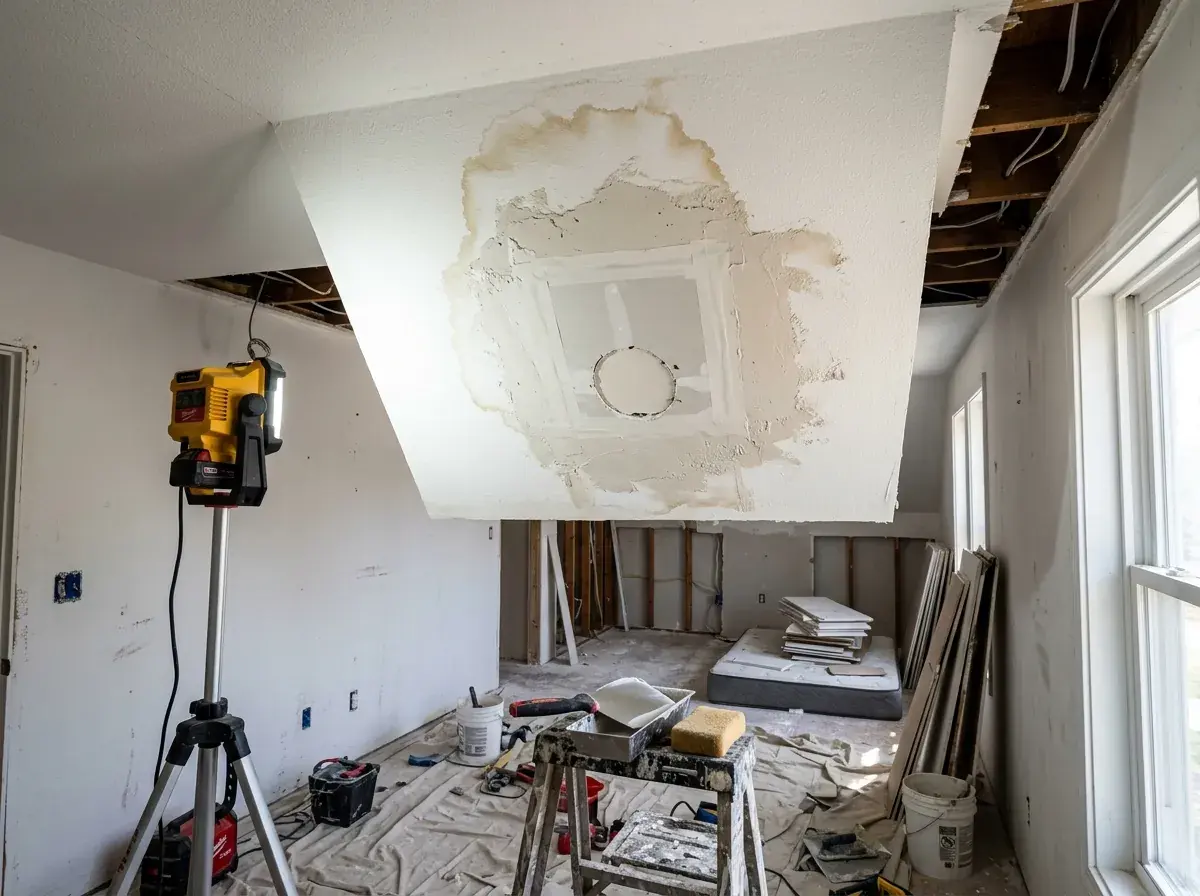
Ask anyone who has lived through a Charleston August: the air here holds water. That is hard on a lot of things in a house, and textured ceilings are near the top of the list. If your popcorn ceiling has yellow rings, a soft spot, dark speckles in the bathroom or texture that flakes when you brush it, humidity is probably involved. Here is what is going on and what to do about it.
Why moisture and popcorn texture do not mix
Popcorn texture is a thin, porous layer of compound and aggregate sprayed over drywall. Porous is the key word. It absorbs airborne moisture, it holds onto it, and it dries slowly. Smooth painted drywall sheds humidity far better because the paint film is continuous; popcorn has thousands of tiny surfaces and crevices for moisture to settle into.
Over decades of humid summers, that absorb-and-release cycle does predictable things:
- Staining and yellowing. Moisture carries dust and tannins through the texture and leaves them behind as it evaporates, which is why older popcorn ceilings look tea-stained even without a leak.
- Loosening and flaking. Repeated wetting weakens the bond between texture and drywall. Texture starts coming off in bathrooms and near exterior walls first.
- Mildew and dark speckles. In bathrooms, laundry rooms and poorly ventilated bedrooms, the texture's surface stays damp long enough for mildew to take hold.
- Sagging. Drywall that stays damp loses stiffness. Combined with the weight of saturated texture, it can bow between joists, especially on ceilings that have had a leak.
Humidity alone rarely destroys a ceiling. It makes an old ceiling look worse, and it turns a small leak into a bigger problem than it would be in a drier climate.
Where it shows up first in Charleston homes
Bathrooms without a working exhaust fan are the most common trouble spot, followed by rooms over crawl spaces with moisture problems, rooms under attic AC air handlers (condensate lines and drain pans), and the ceiling just inside exterior walls in older homes where insulation is thin. On the beaches, salt air and the constant open-window season make it worse; homes on Isle of Palms and Folly Beach often show flaking and staining well before mainland homes of the same age.
Older subdivisions in West Ashley and James Island, where the housing stock is mostly 1960s to 1990s, have ceilings that have simply been through more humid summers than anything built after 2000.
Is it a leak or just humidity?
This matters because the fix is different. Humidity damage is diffuse: general yellowing, flaking across a whole room, mildew spots in a bathroom. Leak damage is local: a defined ring or stain, a soft or sagging patch, a stain that grows after rain or when the AC runs hard.
A ring-shaped stain under a bathroom, the attic air handler or a roof valley is almost always a leak, and it needs to be fixed at the source before any ceiling work. We will tell you if we think a stain is active, but a roofer or HVAC tech should confirm it. Scraping and refinishing over an active leak just means doing the job twice.
Ventilation: the cheapest fix there is
Before you spend anything on the ceiling, make sure the house is moving air. Bathroom exhaust fans should vent to the outside, not into the attic, and should run during and after every shower. Kitchen range hoods should vent outside. Dryers should be properly ducted. Attic ventilation and crawl-space moisture control reduce the humidity load from above and below. And simply running the air conditioning, which dehumidifies as it cools, does more for your ceilings than most people realize.
Fix the ventilation first and a new ceiling finish will last far longer. Skip it and you will be looking at the same stains on a new surface in a few years.
Drying before the finish goes on
When we remove popcorn, the wet-scrape process soaks the ceiling on purpose. In a humid house, that water does not leave quickly on its own. Every stage after scraping depends on the previous stage being dry: the drywall before the skim coat, each skim coat before the next, the final coat before primer, primer before paint.
Finishing over a surface that is still damp underneath is the number one cause of ceiling problems that show up months later: paint that flashes in patches, bubbles, hairline cracks in the compound, and primer that peels in sheets. So we run the AC, bring fans and dehumidifiers into the work area, apply thinner coats and check surfaces before moving on. It adds a day or two to the schedule for a smooth finish, and it is worth every hour. Our post on how long removal takes explains the full timeline.
Repairing water-damaged sections
Once the texture is off, humidity and leak damage are easy to see and fix. Our ceiling drywall repair work typically covers:
- Cutting out and replacing soft, sagging or delaminated drywall
- Re-screwing bowed sections to the joists and re-taping seams that have let go
- Sealing old stains with a stain-blocking primer so they do not bleed through new paint
- Treating mildewed surfaces before any new compound goes on
- Skimming the repaired area into the surrounding ceiling so it disappears under the finish
Small repairs are usually folded into a removal quote. A ceiling that has had a serious leak may need a larger section replaced, which we price separately after seeing it.
Does a smooth ceiling hold up to Charleston humidity?
Yes, and better than popcorn did. A skim-coated, primed and painted ceiling has a continuous film that sheds moisture instead of soaking it up, and it wipes clean. In bathrooms we recommend a mildew-resistant ceiling paint, and in beach houses a light knockdown is a practical choice because it is easy to touch up. Either way, the combination of proper drying, a stain-blocking primer and the right paint is what makes the finish last here.
If your ceiling is showing stains, flaking or soft spots, start with the source, then let us look at the ceiling. Typical pricing is on our cost page, and you can request a free quote any time.
Frequently asked questions
Why is my popcorn ceiling yellowing with no leak?
Porous texture absorbs humid air and releases it over and over. Each cycle leaves behind dust and residue, which is why old popcorn ceilings in Charleston look stained even in rooms that have never leaked.
Can you remove popcorn from a ceiling that has water damage?
Yes, but the leak has to be fixed first. Once the texture is off we replace soft or sagging drywall, seal stains with a blocking primer and skim the repair into the surrounding ceiling before the new finish goes on.
Will a new smooth ceiling get mildew in my bathroom?
Far less than popcorn, because a painted smooth surface sheds moisture instead of absorbing it. A working exhaust fan that vents outside plus a mildew-resistant ceiling paint keeps bathroom ceilings clean for years.